Telling male and female guppies apart is one of the first skills any guppy keeper needs. Whether you want to control breeding, set up the right ratios, or just understand your fish better, knowing how to identify their gender is essential.
The good news? Once you know what to look for, male and female guppies are surprisingly easy to tell apart — much easier than most other fish species.
This guide covers all the key visual and behavioral differences, plus tips for identifying juveniles and tricky cases.
Quick Comparison: At a Glance
Before we dive into details, here’s the simple version:
| Trait | Male Guppy | Female Guppy |
|---|---|---|
| Size | Smaller (1.5–2 in) | Larger (2–2.5 in) |
| Color | Bright and vibrant | Pale and silvery |
| Tail | Large, flowing | Smaller, plain |
| Body shape | Slim and streamlined | Round and full |
| Anal fin | Pointed (gonopodium) | Triangular fan |
| Gravid spot | None | Dark spot near belly |
| Behavior | Active, chases females | Calmer, less active |
For most adult guppies, you can tell within seconds just by looking at color and tail size.
The 6 Key Visual Differences
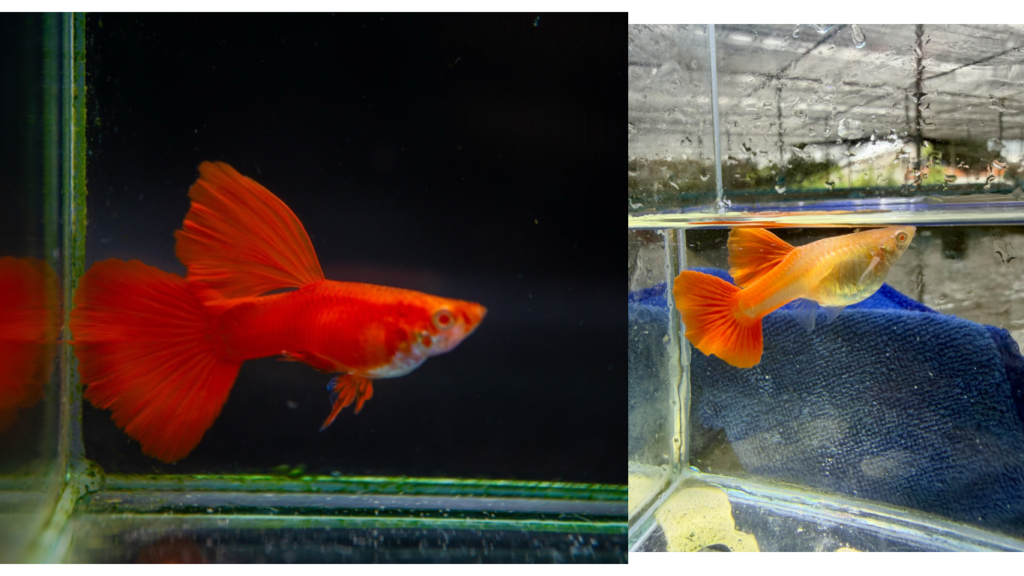
1. Body Size
Females are bigger. Adult females reach 2–2.5 inches, while males stop at 1.5–2 inches.
This size difference becomes obvious around 8–10 weeks of age. Before that, fish are too small for size to be a reliable indicator.
2. Color and Pattern
Males are the colorful ones. They have bright reds, blues, yellows, and metallic shines designed to attract mates.
Females are mostly silver, gray, or pale. Many female guppies have hints of color on their tails, but their bodies stay subdued.
This is opposite of what beginners often expect. In guppies, males look like peacocks while females look like sparrows.
3. Tail Shape and Size
Male tails are huge and flowing. Fancy guppy strains have spectacular tails — delta, half-moon, lyretail, fan, sword.
Female tails are smaller and plainer. They have functional tails for swimming, not show.
In adult fish, you can usually identify gender from across the room by tail size alone.
4. Body Shape
Males are slim and streamlined — built for speed and chasing.
Females are rounder and fuller — built for carrying babies. Pregnant females become noticeably more rounded.
5. The Anal Fin (Most Reliable Sign)
This is the most reliable identifier, especially in juveniles.
Males have a “gonopodium”: a long, narrow, rod-shaped fin used for mating. It looks like a stick pointing backward from the belly.
Females have a regular triangular anal fin that looks like a small fan.
If you flip a guppy over (gently!) or photograph it from underneath, you can see this difference clearly.
6. The Gravid Spot
Only females have it. This is a dark spot near the back of the belly, just before the anal fin. It’s the area where babies develop.
The gravid spot darkens significantly when a female is pregnant. In juvenile females, it’s subtle but still visible.
Males never have a gravid spot.
Behavioral Differences
Beyond appearance, males and females also act differently.
Male Behavior
- Constantly active — swimming, displaying, chasing
- Flashy displays — flaring fins, dancing in front of females
- Chase females persistently — main goal is mating
- Compete with other males — flash and posture
- Eat quickly — high metabolism, always hungry
Female Behavior
- Calmer and steadier — less zooming around
- Often in small groups — prefer female company
- Avoid males — try to escape constant chasing
- Eat at their own pace — less competitive
- Defensive when pregnant — may hide more
If you sit and watch your tank for 10 minutes, you’ll see the gender differences clearly in behavior.
How to Identify Juvenile Guppies
Telling young guppies apart is harder, but possible from about 4 weeks of age.
Steps for Identifying Juveniles
1. Look for the gravid spot. Females develop a dark spot near the back of their belly first. Use a flashlight from behind for better visibility.
2. Check the anal fin. Males start developing their gonopodium between 3–5 weeks old. It looks like a small pointed extension.
3. Watch color development. Males start showing tail color around 4–6 weeks. Females stay mostly silver.
4. Note body shape. Females start to round out as they mature. Males stay slim.
Don’t rely on a single trait. Use multiple signs to confirm.
When You Can Be Sure
By 8–10 weeks of age, all gender differences are usually obvious. If you wait until then, identification is easy.
Common Mistakes in Gender Identification
Beginners often make these errors:
1. Assuming Big Color = Male
Some female guppy strains (especially Endler crosses) have colorful tails. Don’t rely on tail color alone.
2. Mistaking Young Males for Females
Before 4–6 weeks, males can look similar to females. Wait until they’re older to be sure.
3. Confusing Pregnant Females with Males
A pregnant female has a rounded belly, not a gravid spot like a hidden male. Look at fins and overall shape.
4. Buying “All Males” That Include Females
Pet store fish are often mislabeled. Even labeled “all male” tanks can contain a few young females. Recheck after they grow.
5. Thinking Females Don’t Have Color
Many female guppies have subtle color, especially on their tails. Just less than males.
Why Gender Matters
Identifying gender isn’t just for show. It affects:
Tank Stocking
The recommended ratio is 1 male per 2–3 females. This prevents females from being constantly harassed. Knowing your fish’s gender lets you stock correctly.
Breeding Control
Males and females together = babies. Lots of babies. If you don’t want to breed, you need an all-male or all-female setup.
Behavior Management
Knowing who’s who helps you understand stress, aggression, and territorial issues.
Health Monitoring
Pregnant females need different care. Male fights need intervention. Knowing genders helps you spot issues early.
Special Cases
Late Bloomers
Some male guppies develop color late — sometimes not until 4–6 months. If your “female” suddenly grows a colorful tail and a gonopodium, surprise — it was a male.
Hybrid Strains
Endler × guppy crosses, Moscow guppies, and some fancy strains can have unusual coloration. Always check fins and gravid spot, not just color.
Pregnant Females
A heavily pregnant female may look very different from her non-pregnant self. Her belly is bulging and her gravid spot is dark.
Sick or Stressed Fish
Stress can fade colors temporarily. A male might look paler than usual when sick. Look at fins and behavior, not just color.
Practical Identification Tips
1. Use a bright light. Hold a flashlight near the tank for better viewing of subtle traits.
2. Take photos. Photos help you study the fish without stressing them.
3. Compare in groups. It’s easier to compare fish to each other than identify them in isolation.
4. Watch over time. Behavior unfolds across days. Color develops over weeks.
5. Don’t stress them. Avoid netting fish just to check gender. Patience reveals everything.
6. Use experienced help. Local fish stores or online forums can confirm gender when you’re unsure.
FAQ
Can female guppies turn into males?
No, but females may develop male-like features (color, slight gonopodium) due to hormonal issues in rare cases. This is called “spontaneous sex reversal” and is very uncommon.
At what age can I tell male from female guppies?
Around 4 weeks for early signs, 8–10 weeks for certainty.
Are male guppies more aggressive than females?
Yes, especially toward other males. They display and chase constantly.
Why are male guppies more colorful?
Sexual selection. Females choose mates based on color, so males evolved to be flashy.
Can I keep just males?
Yes! All-male tanks work great and are colorful without breeding hassle.
How can I tell if my female guppy is pregnant?
Look for a dark gravid spot, a square-ish belly shape, and increased hiding behavior.
Do males live shorter lives than females?
Yes. Males typically live 1.5–2.5 years, females 2–3.5 years.
What if I bought guppies labeled as one gender but got mixed?
This is common. Recheck after they grow. Adjust your stocking accordingly.
Final Thoughts
Identifying male and female guppies is a skill you’ll use constantly as a guppy keeper. The good news is that adult guppies are obvious once you know what to look for.
Three simple identifiers to remember:
- Color and tail. Bright + flowing = male. Plain + small = female.
- Anal fin. Pointed = male. Triangular = female.
- Gravid spot. Only females have it.
Get comfortable with these, and you’ll be sorting guppies like a pro in no time.
For more guppy care guides, check out our Complete Guppy Care Guide, How to Set Up a Guppy Tank, and How Many Guppies in a Tank.
Happy fishkeeping! 🐟